

Lateral earth pressures are horizontal pressure exerted by soil when in contact with vertical or inclined structures such as retaining walls, basement walls, tunnels, sheet piles, underground sewers, etc. The amount of lateral pressure exerted by earth on these vertical structures depends on wall movement, shear strength parameter of the soil, unit weight of the soil, and drainage condition in the back fill.
The earth pressure exerted on walls can be categorized based on the movement of those walls into three:
- At rest earth pressure
- Active earth pressure
- Passive earth pressure
At REST EARTH PRESURE
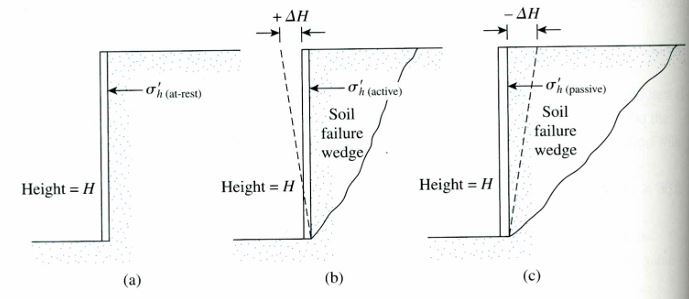
Lateral pressure at rest occurs when the wall retaining the soil neither moves away nor into the soil. This is the case for walls that are restrained from moving such as basement walls, and walls with tie-backs. Most earth retaining structures are designed for at rest pressure as it balances between the conservativeness of passive earth pressure and the potential-underestimation due to active earth pressure.
The pressure on a wall at rest is given as:
Koϒh
where;
ϒ is the unit weight of soil
H is the height of soil
Ko is the coefficient of soil pressure at rest (which will be discussed later below)
ǿ is the angle of internal friction
Active Earth Pressure
Active earth pressure occurs when the wall yields such that it moves away from the retained soil or backfill. The portion of the retained soil that is just behind the wall also moves along with it, leaving the rest of soil mass. This portion of the backfill which moves along with the wall is termed as failure wedge.
This is the case for structures such as cantilever retaining walls, gravity retaining walls etc.
The active pressure on a wall is given as:
σa = Kaϒh – 2C’√Ka
where;
Ka = Active pressure coefficient
C’ = cohesion of the soil
Θ = friction angle
For granular soil where C’ = 0
σa = Kaϒh
Active force before tensile crack
1/2 ϒh²Ka – 2C’h√Ka
Active force after tensile crack
1/2 ( h – zc) (ϒhKa – 2C’√Ka)
zc = 2C’/ϒKa
Passive Earth Pressure
Passive earth pressure occurs when the wall moves into the retained soil. This is the most conservative of the earth pressures but rarely designed for in practice. For passive pressure to mobilize the wall would have been greatly unstable with substantial rotation about its heel. And for situations where the passive pressure would have been favorable such as in the case of underground liquid containing structures, the passive pressure is often ignored as the time lag before it is sufficiently mobilized can be much.
The passive earth pressure is given as:
σp = Kpϒh + 2C’√Kp
where;
Kp = passive pressure coefficient
C’ = cohesion of the soil
Θ = friction angle
For granular soil where C’ = 0
σp =Kpϒh
Force by passive pressure = 1/2 ϒh²Kp + 2C’h√Kp
Soil as Semi-fluid
Soil is not a true fluid like water so it doesn’t exert all its vertical pressure in the horizontal direction. There is a need to quantify the amount of the vertical pressure a soil mass exerts horizontally; this is what bring about the concept of coefficient of lateral earth pressure. The lateral earth pressure coefficient (K) determines the ratio of the lateral earth pressure to the vertical earth pressure. This is categorized based on the type of pressure as related to the movement of the wall as enumerated below:
- At-rest lateral pressure coefficient (Ko)
- Active lateral earth pressure coefficient (Ka)
- Passive lateral earth pressure coefficient (Kp)
At-Rest Lateral Earth pressure coefficient
The at-rest lateral earth pressure coefficient (Ko) can be determined using empirical formula.
For consolidated soil:
Ko = 1 – Sinǿ
ǿ is the angle of internal friction
For over-consolidated soil:
Ko = (1−sin(ϕ′))OCRsin(ø)
where;
OCR is the over-consolidated ratio
Active and Passive Lateral Earth Pressure Coefficients
Two theories are commonly used to determine the active and passive lateral earth pressure coefficients. These are:
- Rankine’s theory
- Coulomb’s theory
The Rankine’s Theory
Rankine theory is used to determine the active and passive earth pressure coefficient base on the following assumptions
- The soil is granular and homogeneous
- The wall is frictionless
- The face of the wall is vertical
Because of these assumptions, ideally, the Rankine’s theory is better suited for determining the lateral pressure within a soil mass and not the lateral earth pressure against a wall.
The general Rankine’s lateral active pressure coefficient is given as:
$
K_a\,\,=\,\,\cos \beta \left[ \frac{\cos \beta \,\,-\left( \cos ^2\beta \,\,-\,\,\cos ^2\phi \right) ^{\text{1/}2}}{\cos \beta \,\,+\,\,\left( \cos ^2\beta \,\,-\,\,\cos ^2\phi \right) ^{\text{1/}2}} \right]
$
If the embarkment is leveled such that β = 0, the equation becomes:
$$
K_a\,\,=\,\,\frac{\text{1\,\,}-\,\,\sin \phi}{\text{1\,\,}+\,\,\sin \phi}\,\,=\,\,\tan 2\left( \text{45\,\,}-\,\,\frac{\theta}{2} \right)
$$
The coefficient for passive pressure is:
$
K_p\,\,=\,\,\cos \beta \left[ \frac{\cos \beta \,\,+\left( \cos ^2\beta \,\,-\,\,\cos ^2\phi \right) ^{\text{1/}2}}{\cos \beta \,\,-\,\,\left( \cos ^2\beta \,\,-\,\,\cos ^2\phi \right) ^{\text{1/}2}} \right]
$
$$
K_p\,\,=\,\,\frac{\text{1\,\,}+\,\,\sin \phi}{\text{1\,\,}-\,\,\sin \phi}\,\,=\,\,\tan 2\left( \text{45\,\,}-\,\,\frac{\theta}{2} \right)
$$
The Coulomb’s Theory
The coulomb’s theory is more detailed as it accounts for soil internal friction (𝜙), slope of the wall to the horizontal (𝛽), slope of the backfill to the horizontal (𝛼), angle of friction between soil and the wall (𝛿).
The Coulomb theory provides a method of analysis that gives the resultant horizontal force on a retaining system for any slope of wall, wall friction, and slope of backfill provided

The general formula for Coulomb’s lateral earth pressure coefficients for both active and passive pressures are given below:
$$
K_a\,\,=\,\,\frac{\sin ^2\left( \beta \,\,+\,\,\phi \right)}{\sin ^2\beta \,\,\sin \left( \beta \,\,-\,\,\delta \right) \,\,\left[ \text{1\,\,}+\,\,\sqrt{\frac{\sin\text{\,\,}\left( \phi \,\,+\,\,\delta \right) \,\,\sin\text{\,\,}\left( \phi \,\,-\,\,\delta \right)}{\sin\text{\,\,}\left( \beta \,\,-\,\,\delta \right) \,\,\sin\text{\,\,}\left( \alpha \,\,+\,\,\beta \right)}} \right] ^2}\,\,
$$
$$
K_p\,\,=\,\,\frac{\sin ^2\left( \beta \,\,-\,\,\phi \right)}{\sin ^2\beta \,\,\sin \left( \beta \,\,+\,\,\delta \right) \,\,\left[ \text{1\,\,}+\,\,\sqrt{\frac{\sin\text{\,\,}\left( \phi \,\,+\,\,\delta \right) \,\,\sin\text{\,\,}\left( \phi \,\,+\,\,\delta \right)}{\sin\text{\,\,}\left( \beta \,\,+\,\,\delta \right) \,\,\sin\text{\,\,}\left( \alpha \,\,+\,\,\beta \right)}} \right] ^2}\,\,
$$
In practical design of retaining walls, the wall friction angle is always less than 𝜙. Its actual value is taken to be between 𝜙/2 and 2 𝜙 /3.
Coulomb’s lateral earth coefficient formulas can be simplified by assuming the wall is vertical (i.e. β = 90) and the backfill is horizontal (i.e.: ∝ = 0). When zero wall friction (i.e.:δ = 0) is added to the aforementioned two simplifications, the Coulomb’s theory effectively becomes Rankine’s.
References
Principles of Foundation Engineering.