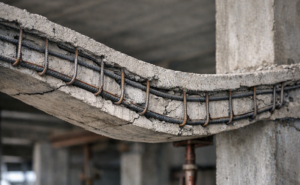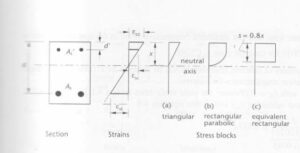


Concrete’s strength and ductility can be dramatically improved when it is confined, either by transverse reinforcement, external pressure, or localized loading conditions. Confinement prevents premature cracking and allows concrete to sustain higher stresses and strains, making it especially important in columns, seismic design, and heavily loaded members. This article walks the reader through the concept of confined concrete as espouses in EN 1992-1-1.
Types of Confinement
EN 1992-1-1 treats confinement as an independent triaxial state of stress regardless of the source. It does not explicitly group confined concrete; however, they can be group into active and passive for learning purpose.
- Passive Confinement: Passive confinement is a type where lateral pressure (confining pressure) is applied after lateral expansion (dilation) of the concrete from loading. This is often the case for concrete confined by transverse reinforcement such as ties and spiral. The links or cross-ties are adequately anchored to resist bursting stresses from the transverse pressure from loading.
- Active Confinement: Active confinement is a type where lateral pressure is applied before loading. This is what occurs in the case of prestressing, jacketing, etc.
Stress Strain Model for Confined Concrete
Confined concretes have enhanced curve compared to unconfined concrete due to higher peak stress and extended strain capacity. The stress-strain relationship of confined concrete is provided below as excerpted from fig 3.6 of EN 1992-1-1

The increase characteristic strength and strain due to confinement can be modelled mathematically as shown below:
Confined compressive strength $\left(f_{c k, c}\right)$
$$
\begin{aligned}
& f_{c k, c}=f_{c k}\left(1.0+5 \frac{\sigma_2}{f_{c k}}\right) \text { for } \sigma_2 \leq 0.05 f_{c k} \\
& f_{c k, c}=f_{c k}\left(1.125+2.5 \frac{\sigma_2}{f_{c k}}\right) \text { for } \sigma_2>0.05 f_{c k}
\end{aligned}
$$
Confined peak strain $\left(\varepsilon_{c 2, c}\right)$
$$
\varepsilon_{c 2, c}=\Sigma_{c 2}\left(\frac{f_{c k, c}}{f_{c k}}\right)^2
$$
Confined ultimate strain $\left(\varepsilon_{c u 2, c}\right)$
$$
\varepsilon_{c u 2, c}=\varepsilon_{c u 2}+0.2\left(\frac{f_{c k, c}}{f_{c k}}\right)^2
$$
Effective Lateral Stress (σ2)
EN 1992-1-1 does not give an explicit iterative formula to find the effective lateral stress σ2 . Designers typically rely on other resources for the actual calculation of effective lateral stress. This is deliberate so that Eurocode provides the framework and it is agnostic of the source of effective lateral stress.
Partially Loaded Area as a Special Case of Confined Concrete
When a high concentrated load is applied to a small area (Aco ) on a large concrete block (Ac1) the concrete is in a triaxial state of stress. The surrounding mass of concrete around the small, loaded area confines it and enhance its compression resistance thereby preventing a crushing failure.

The favorable effects of confinement are only valid if the distribution area (Ac1) has the same center of gravity as the loaded area (Aco). If the column is at the very edge of a plinth, there is no confinement benefit to be taken into account.
The resistance of a locally loaded area can be enhanced using $\sqrt{\frac{A c 1}{A c o}}$ so that the concentrated resistance force is determined as:
$$
F_{R d u}=A_{c 0} f_{c d} \sqrt{\frac{A c 1}{A c o}} \leq 3.0 A_{c 0} f_{c d}
$$
As shown above, regardless of the size of the distribution area (Ac1) the concrete should never be taken to be more than 3 times its design strength to prevent against punching failure.
Prevention against Bursting
Partially loaded area of large concrete, unlike columns which are already restrained by ties and spirals, have the tendency to develop cracks (burst) due to transverse tensile stress under extreme concentrated load. This cracking of concrete surrounding the loaded area eventually leads to the loss of the confinement effect and the whole structure would eventually fail. To prevent this, reinforcement to resist the tensile stress (bursting reinforcement) has to be provided as stated in Clause 6.7(4).